THE MUSICAL SCENE IN THE LATE 1880s
What were Strauss’s contemporaries doing around the time that Don Juan exploded onto the musical scene in 1889? Let’s have a look (and listen!)…
Puccini, like Strauss, devoted most of his career to opera. Puccini was definitely a world-famous composer whose operas were extremely popular on four continents. He was certainly the greatest Italian composer after Verdi, who died in 1901. Strauss, who was one of the most important opera conductors working at the beginning of the 20th century, conducted the works of Puccini regularly. His famous comment regarding Puccini is: "Ja-Ja, very beautiful, all melody, all melody! Everyone thinks I am hostile to Puccini. It isn't true. But I can't listen to his operas because if I do I can't get the melodies out of my head afterwards. And I can't write Puccinian Strauss." And what did Puccini think of Strauss's shocking Salome? "The most extraordinary, terribly cacophonous thing. There are some very beautiful orchestral sounds, but it ends by tiring one out. It is a most gripping spectacle". A mere six years separates these composers’s birth years. Begun in 1889 and first premiered in 1893, Manon Lescaut is considered to be Puccini’s first operatic masterpiece. Heard below is a famous aria from the opera.

Giacomo Puccini (1858-1926)
Puccini: Donna non vidi mai, from Manon Lescaut (1893)
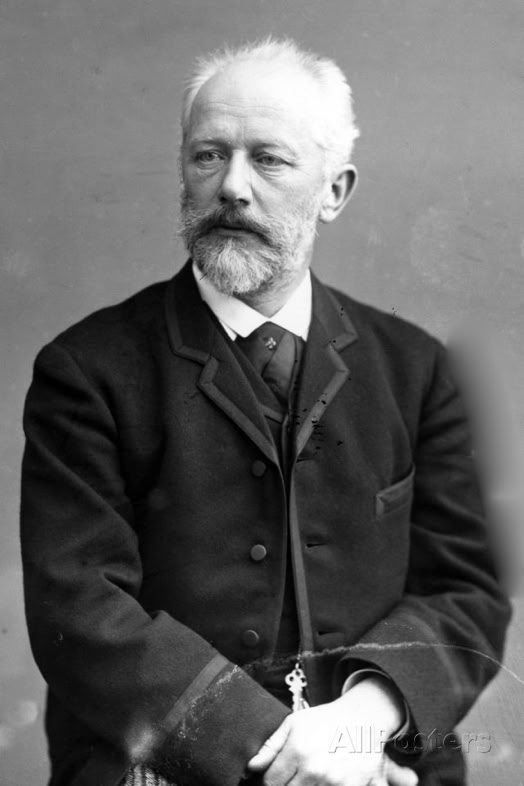
Tchaikovsky’s Symphony No. 5 in E minor (1888) is a sweeping, emotional journey from fate and despair to triumph and renewal. Its recurring “fate theme” unifies the symphony, weaving through somber introspection, graceful waltz, and exuberant finale. Though a generation apart, Richard Strauss admired Tchaikovsky’s orchestral mastery and expressive power—qualities that influenced Strauss’s own lush Romantic sound world and his early tone poems, bridging the emotional directness of Tchaikovsky with the vivid modernism of the new century. And what did Tchaikovsky think of Richard Strauss? In a letter to his brother Modest, Tchaikovsky wrote: “I heard a work by a new German genius, Richard Strauss. Bülow is fussing over him just as he once did over Brahms and others. I don't think there has ever been a more outrageously talentless person, yet quite full of pretensions, as this Richard Strauss..”
Pyotr Tchaikovsky (1840-1893)
Tchaikovsky: Symphony No. 5, third mvt. (1888), Manfred Honeck with the Frankfurt Radio Symphony
Mahler and Strauss: a complicated situation, to put it mildly. Here were two of the giant conductors of the era, as well as two of the absolute giants of composition. They were allies and friends as well as promoters of each others' works. It should be remembered that during most of Mahler's life he was much better known as a conductor than as a composer. His works did not meet with the same rapt enthusiasm as many of the famous works of Strauss. Strauss wrote the following upon first meeting Mahler: "I made a new and very attractive acquaintance in Herr Mahler, who seemed to me to be a highly intelligent musician and conductor--one of the few modern conductors who know about tempo rubato".Mahler worked hard to have Strauss's Salome performed at the Vienna State Opera, where he was Music Director, and the refusal of the Opera to perform this revolutionary work was one of the reasons for Mahler's departure from Vienna in 1907. As for Mahler's opinion of Strauss, here is an excerpt from a letter to Strauss regarding Salome: "I simply must tell you of the thrilling impression the work made when I read through it recently. It is the high point to date. I would even say that nothing you have done so far can stand comparison with it." When Mahler died in 1911, Strauss was unable to work for days and would scarcely speak.
Mahler composed his Symphony No. 1 in 1888, the same year that Strauss composed Don Juan! And what different worlds the occupy! Offered here is the third movement, with Mahler’s own words regarding the “program” of this movement, as well as some personal annotations of mine.
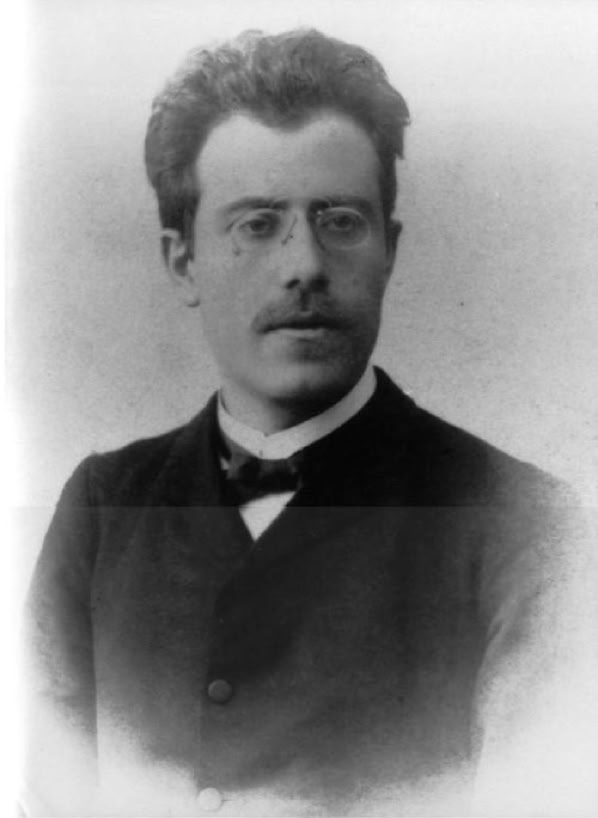
Gustav Mahler in 1888
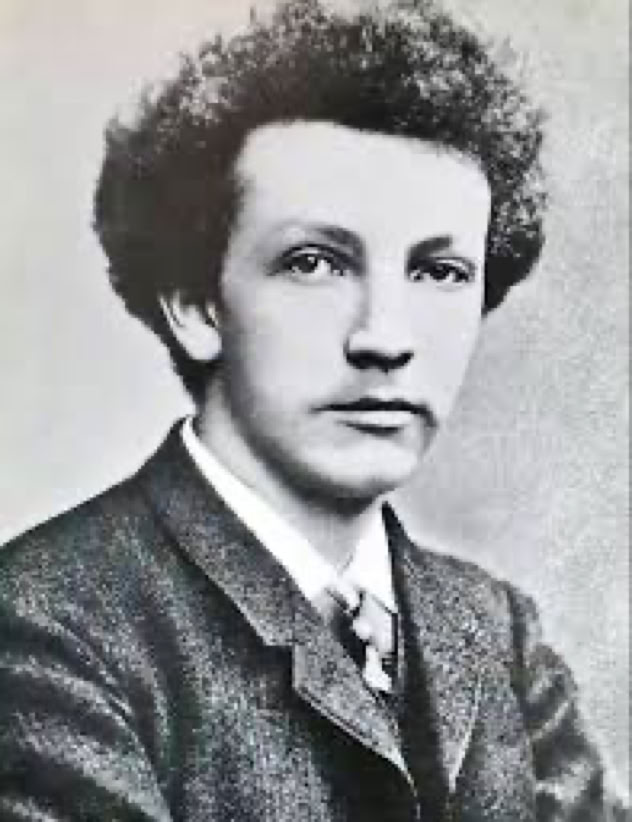
Richard Strauss in 1888
Mahler: Symphony No. 1, third mvt. (1888) Andrés Orozco-Estrada conducting the Frankfurt Radio Symphony
Mahler: Symphony No. 1, third mvt. (1888) Andrés Orozco-Estrada conducting the Frankfurt Radio Symphony
Johannes Brahms exerted a deep—if complex—influence on the young Richard Strauss. Through his father’s admiration for Brahms and the rigorous classical training of Hans von Bülow, Strauss absorbed Brahms’s mastery of structure, motivic development, and absolute (non-programmatic) form. Even as Strauss later embraced the freer, narrative style of Liszt and Wagner, his orchestral writing retained Brahmsian craftsmanship—careful motivic unity, dense contrapuntal textures, and a rich harmonic vocabulary. Brahms and Richard Strauss met several times during Strauss’s early career, most notably in the 1880s, when the young composer was still under the influence of the conservative musical ideals of his teacher, Hans von Bülow. Brahms, though generally reserved in his opinions, is said to have encouraged Strauss, praising his youthful compositions for their solid craftsmanship. Strauss, for his part, admired Brahms’s structural mastery but found his music emotionally restrained. As Strauss’s allegiance shifted toward Wagner and Liszt, he grew distant from Brahms’s aesthetic, later remarking that Brahms “wrote with his head, not his heart.” Despite this, Brahms’s influence—especially his command of form and thematic development—remained a crucial foundation for Strauss’s mature style. The Double Concerto was the last orchestral work that Brahms would compose.
Video Player

Johannes Brahms (1833-1897)
Video Player
Brahms: Double Concerto mvt. 3 (1887), Anne-Sophie Mutter, violin/Maximilian Hornung, cello
Video Player
Saint-Saëns, like Strauss, lived to the ripe old age of 86 and was still composing right up to the very end of his long life. Unlike Strauss, however, Saint-Saens never ventured into the 20th century with regard to his composing, being very conservative. He had no use for "contemporary" composers in the early 20th century and could pour scathing criticisms on his fellow composers. With regard to Ravel, he wrote: "If he had been making shells during the war (WWI) it might have been better for music". Saint-Saëns was still a highly respected and incredibly popular composer even late in life, known all over the world and performed everywhere. One can only guess what his opinion of Salome was! His “Organ” Symphony (No. 3) from 1886 is considered to be one of his finest works. The Scherzo third movement is heard here.
Camille Saint-Saëns (1835-1921)
Video Player
Camille Saint-Saëns: Symphony No. 3 “Organ” (1886) — Paavo Järvi with the Orchestra de Paris
During the 1880s, Antonín Dvořák emerged as an internationally recognized composer, blending Czech folk idioms with classical forms to create music of warmth, lyricism, and national pride. This decade saw masterpieces such as the Slavonic Dances, Symphonies Nos. 7, & 8, and the opera Dimitrij. Dvořák’s reputation spread across Europe, supported by Johannes Brahms and publisher Fritz Simrock. He developed a mature symphonic voice that balanced folk-inspired melodies with structural sophistication. Living mainly in Prague but often visiting Vienna and London, Dvořák became a symbol of Czech cultural identity, standing at the intersection of Romantic expression and nationalist inspiration.
There’s no definitive record of Antonín Dvořák and Richard Strauss ever meeting in person, though they were certainly aware of each other’s music. Dvořák was already internationally famous when Strauss was emerging as a young composer in the late 1880s and early 1890s. Strauss admired Dvořák’s craftsmanship but pursued a very different aesthetic path, moving quickly toward the bold harmonic and psychological world of his tone poems and operas.
Antonín Dvořák (1841-1904)
Video Player
Dvořák Symphony No. 8 Finale (1889), WDR Symphony Orchestra with Cristian Măcelaru, conductor

Claude Debussy (1862-1918)
During the 1880s, Claude Debussy’s musical style began to take shape, moving away from academic traditions toward a more personal and coloristic language. After winning the Prix de Rome in 1884, he spent time in Italy, where exposure to Renaissance art and contemporary music broadened his imagination. Debussy grew increasingly disillusioned with the rigid French academic style and drew inspiration instead from Russian composers like Mussorgsky and from Javanese gamelan music heard at the 1889 Paris Exposition. By the decade’s end, his early songs and piano works revealed his fascination with tonal ambiguity, modal harmony, and evocative atmosphere—hallmarks of his mature style.
In February of 1887 , he had written to the bookseller Émile Baron: “I have in mind to compose a work in a very special colour which should cover a great range of feelings. It is to be called Printemps, not a descriptive Printemps, but a human one. I should like to express the slow and laboured birth of beings and things in nature, their gradual blossoming, and finally the joy of being born into some new life. All this is without a programme, for I despise all music that has to follow some literary text…”
This show Debussy going in a completely different direction than Richard Strauss, and, in a very real sense, the future belonged to Debussy!
Enter Text