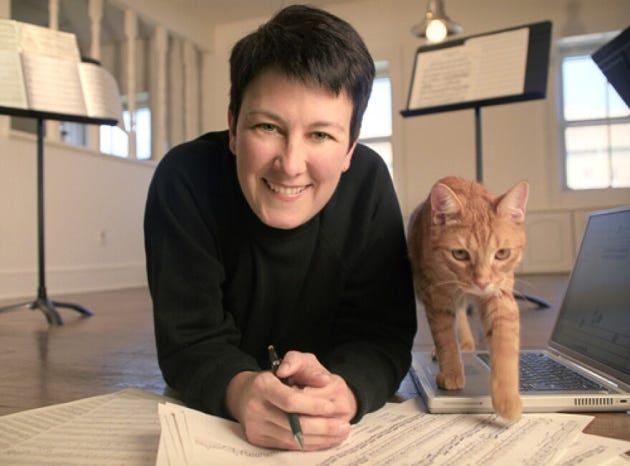
Jennifer Higdon
blue cathedral (1999)
PROGRAM NOTES & COMMENTARY
blue cathedral
Genre: Symphonic; Country: USA
Period: 20th century
Completed in 1999
First performance: Curtis Institute of Music, 2000
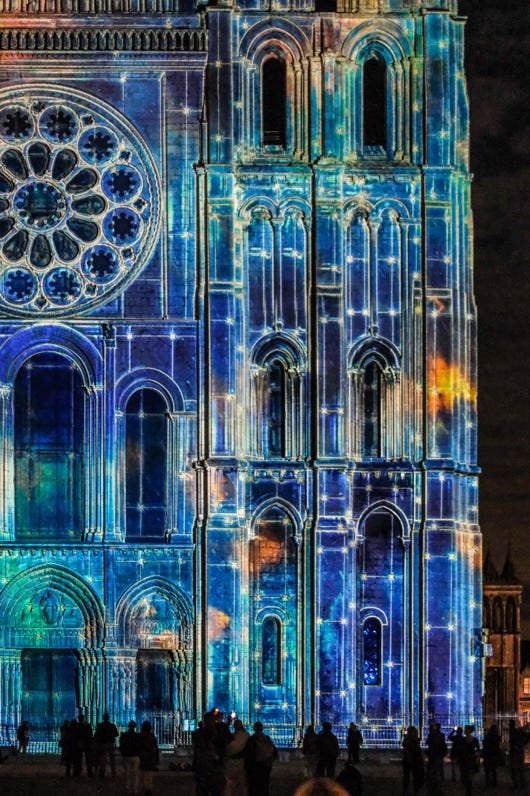
“blue cathedral” Blue…like the sky. Where all possibilities soar. Cathedrals…a place of thought, growth, spiritual expression…serving as a symbolic doorway in to and out of this world. Blue represents all potential and the progression of journeys. Cathedrals represent a place of beginnings, endings, solitude, fellowship, contemplation, knowledge and growth. As I was writing this piece, I found myself imagining a journey through a glass cathedral in the sky. Because the walls would be transparent, I saw the image of clouds and blueness permeating from the outside of this church. In my mind's eye the listener would enter from the back of the sanctuary, floating along the corridor amongst giant crystal pillars, moving in a contemplative stance. The stained glass windows' figures would start moving with song, singing a heavenly music. The listener would float down the aisle, slowly moving upward at first and then progressing at a quicker pace, rising towards an immense ceiling which would open to the sky…as this journey progressed, the speed of the traveler would increase, rushing forward and upward. I wanted to create the sensation of contemplation and quiet peace at the beginning, moving towards the feeling of celebration and ecstatic expansion of the soul, all the while singing along with that heavenly music.
These were my thoughts when The Curtis Institute of Music commissioned me to write a work to commemorate its 75th anniversary. Curtis is a house of knowledge--a place to reach towards that beautiful expression of the soul which comes through music. I began writing this piece at a unique juncture in my life and found myself pondering the question of what makes a life. The recent loss of my younger brother, Andrew Blue, made me reflect on the amazing journeys that we all make in our lives, crossing paths with so many individuals singularly and collectively, learning and growing each step of the way.
This piece represents the expression of the individual and the group…our inner travels and the places our souls carry us, the lessons we learn, and the growth we experience. In tribute to my brother, I feature solos for the clarinet (the instrument he played) and the flute (the instrument I play). Because I am the older sibling, it is the flute that appears first in this dialog. At the end of the work, the two instruments continue their dialogue, but it is the flute that drops out and the clarinet that continues on in the upward progressing journey. This is a story that commemorates living and passing through places of knowledge and of sharing and of that song called life. This work was commissioned and premiered in 2000 by the Curtis Institute of Music.
--Jennifer Higdon

Jennifer Higdon with her brother Andrew and father
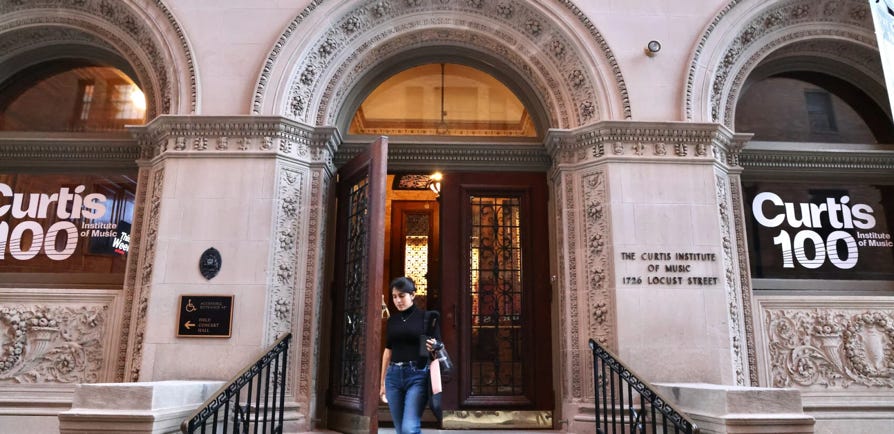
The Curtis Institute of Music in Philadelphia
An Interview With Jennifer Higdon: “blue cathedral”
COMMENTARY
Jennifer Elaine Higdon (b. December 31, 1962) is one of America’s most celebrated contemporary classical composers. Born in Brooklyn, New York, she spent her early childhood in Atlanta, Georgia, before her family relocated to Seymour, Tennessee. Higdon’s introduction to music was unconventional: she grew up in a household with little exposure to classical repertoire, instead absorbing rock and folk records of the 1960s. It wasn’t until high school that she encountered formal music training, joining the concert band as a percussionist and later picking up the flute—an instrument she taught herself to play using an old method book purchased by her mother. Higdon pursued flute performance at Bowling Green State University, where she studied under Judith Bentley. Despite entering college with limited theory and keyboard skills, she quickly distinguished herself as a diligent and resilient student. It was there that conductor Robert Spano, teaching a conducting course, became an early champion of her work, programming her compositions with university ensembles. After earning her bachelor’s degree, Higdon continued her studies at the Curtis Institute of Music, obtaining an Artist’s Diploma under the tutelage of David Loeb, and later completed both a Master of Arts and a Ph.D. in composition at the University of Pennsylvania, studying with avant-garde composer George Crumb.

Flutist Higdon with Judith Bentley
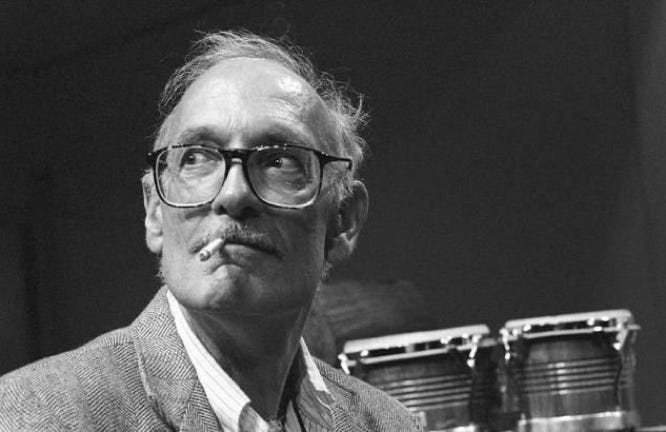
George Crumb
From 1994 until 2021, Higdon served on the faculty of the Curtis Institute of Music, holding the Milton L. Rock Chair in Compositional Studies. Her tenure there not only influenced a generation of emerging composers but also allowed her to refine her own voice, balancing academic rigor with a deeply expressive musical language. She has held Composer-in-Residence posts with numerous major ensembles, including the Pittsburgh Symphony Orchestra, the Green Bay Symphony Orchestra, and the Philadelphia Orchestra, fostering close collaborations that led to acclaimed premieres.
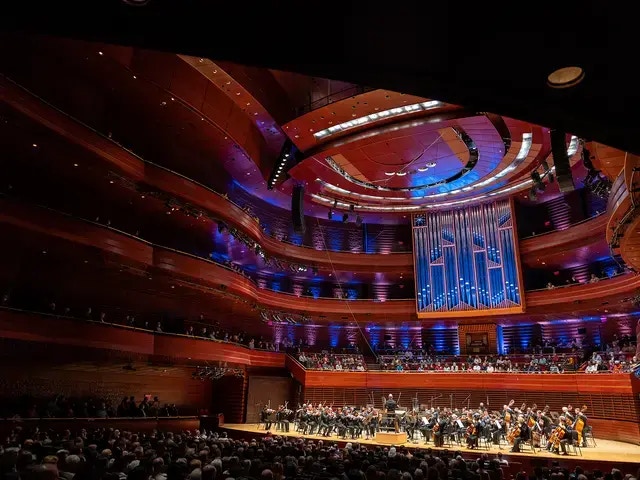
The Philadelphia Orchestra
A hallmark of Higdon’s oeuvre is its accessibility and vivid orchestration. Her catalog spans large-scale orchestral works—such as the Grammy-winning Percussion Concerto (2010) and the Viola Concerto (2018)—to chamber music, wind ensemble pieces, choral works, and opera. Critics often highlight her gift for melodic clarity, rhythmic vitality, and colorful instrumental textures. In works like “City Scape” (2002), she translates urban energy into music, while her chamber settings, such as the award-winning Harp Concerto (2020), showcase her nuanced interplay between soloist and ensemble.
Higdon’s Concerto 4:3. A brilliant example of contemporary writing that is accessible and engaging…
Now based in Philadelphia, Higdon continues to compose, teach masterclasses, and engage in residencies. Her approachable yet sophisticated style, coupled with a commitment to education and mentorship, ensures that her influence will resonate with audiences and musicians for generations to come. Higdon’s contributions have earned her some of the highest honors in American music. She received the 2010 Pulitzer Prize for Music for her Violin Concerto, premiered by Hilary Hahn, and has won three Grammy Awards for Best Contemporary Classical Composition. In 2019, she was elected to the American Philosophical Society, and in 2022, to the American Academy of Arts and Letters. Her works are performed regularly by leading
orchestras worldwide, cementing her reputation as one of the most
performed living American composers.
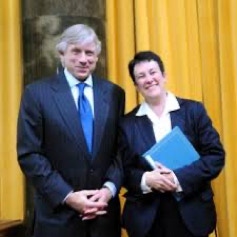
Lee C. Bollinger, President of Columbia University, presents the 2010 Pulitzer Music prize to Jennifer Higdon.
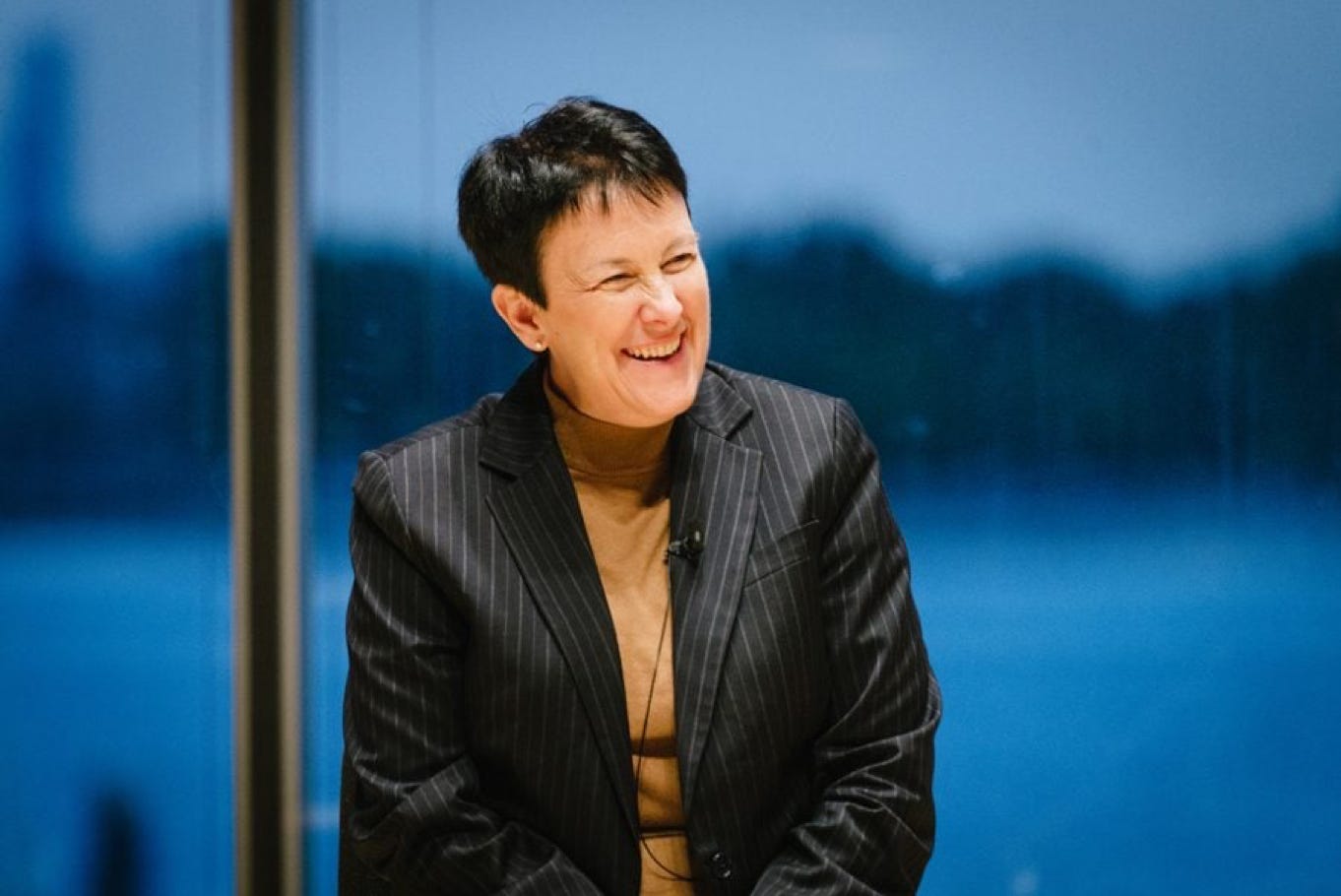
“We all cross paths with a lot of people,” says Higdon. “You don’t see where the puzzle pieces are coming from, but they all fit.”
Lorem ipsum dolor sit amet, consectetur adipiscing elit. Aliquam tincidunt lorem enim, eget